

|
Giants compete to enter the whole house intelligent market, and through a new round of financing, it can be seen that ORVIBO has become a powerful playerShenzhen ORVIBO Technology Co., Ltd. has officially completed a new round of financing. An internet company, China Renaissance New Economy Fund, Suofeiya, Fusenmei and Pingxiang state capital participated, with total investment of 1 billion yuan. Public shareholder-register disclosures identify the internet company as Tencent. This is the largest single financing round in China's smart-home industry to date. The proceeds will be used for innovation in smart-home products and systems, R&D investment in whole-home intelligent operating systems and AIoT artificial intelligence technology, and building out the smart-home ecosystem and retail platform.  Before this, smart-home manufacturers including Baidu's Xiaodu Technology, Xiaomi ecosystem company Aqara and smart-lock maker Kaadas had each secured financing, while Hikvision spun off its smart-home business for an independent listing, filing for the STAR Market with plans to raise 3.7 billion yuan. As an emerging industry, smart home is deeply favoured by capital. In this writer's view, the reasons are twofold: first, smart home has broad prospects, with a global market opportunity worth hundreds of billions of dollars; second, consumers maintain strong demand for all kinds of smart devices, and as the ecosystem matures the industry is shifting toward whole-home intelligence, driving vigorous growth. Smart Home Has Become a Major Consumer-Tech Market, with China's Shipments Set to Top 500 Million Units Data from authoritative research firm Omdia shows that by 2025 the global smart-home market is expected to exceed US$178.5 billion, with a compound annual growth rate of 24.1% over 2020–2025. A study published by Strategy Analytics, Global Smart Home Forecast 2021, predicts that worldwide consumer spending on smart-home products and services will break the US$100 billion mark in 2021, reaching US$123 billion — up 44% year on year — and that the smart-home market will grow to US$173 billion by 2025. 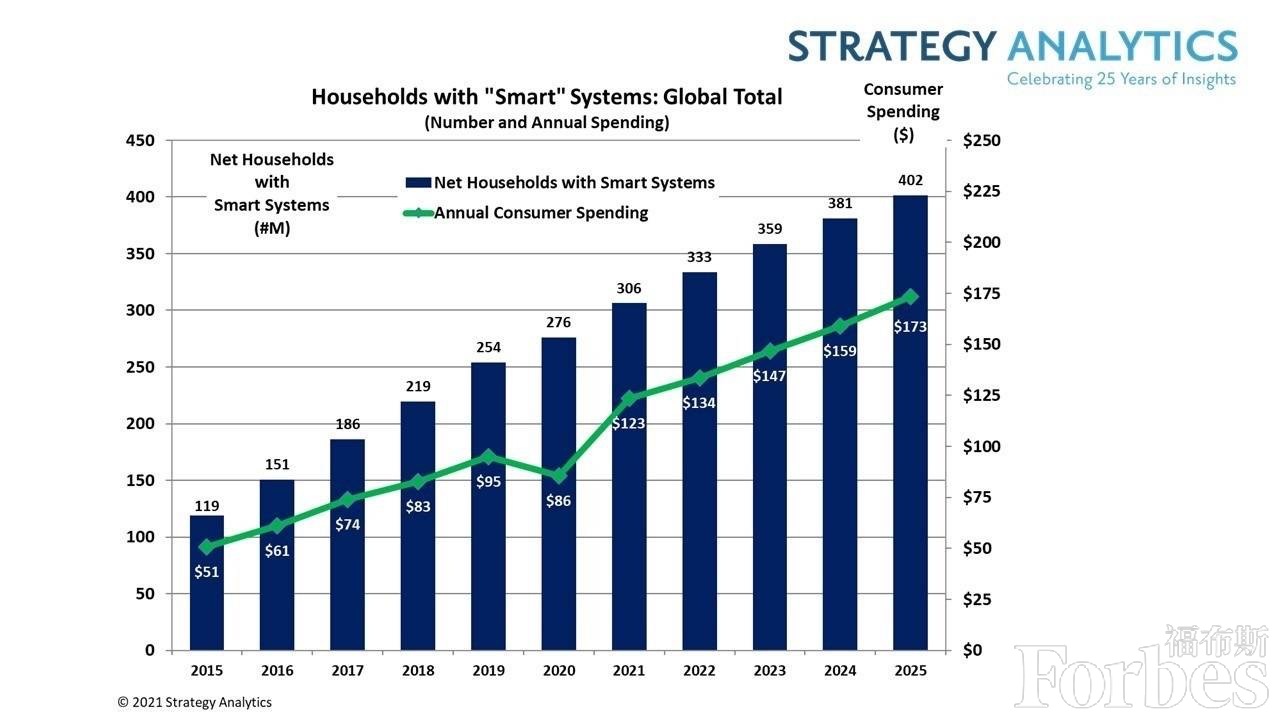 Third-party data consistently shows that smart home has become a major global consumer-tech market, driven by strong consumer demand for smart appliances, smart lighting, smart cameras and smart speakers. The report also shows that by region, North America is the largest market, accounting for 40% of all smart-home spending, followed by Asia-Pacific at 29% — but in the coming years Asia-Pacific will become the largest smart-home market. This is largely because China has a huge user base and steadily rising household incomes, factors that have driven the rapid development of China's smart-home market over the past few years — and with it the continued expansion of the Asia-Pacific market. IDC's China Smart Home Device Market Quarterly Tracker, Q2 2021 shows that in the first half of 2021 China's smart-home device shipments reached about 100 million units, with full-year shipments forecast at 230 million units, up 14.6% year on year. IDC predicts a 21.4% compound annual growth rate over the next five years, with shipments approaching 540 million units in 2025. A Battlefield of Rivals — and ORVIBO Leads This Niche Globally, tech giants such as Amazon, Google, Apple and Samsung are the strongest smart-home players. China, by contrast, presents a scene of a hundred schools contending: giants are rushing into the field — phone makers like Xiaomi and Huawei, internet giants like Baidu and Alibaba, home-appliance giants like Haier and Midea — while a host of innovative smart-home companies such as EZVIZ, Viomi, ORVIBO and Kaadas have emerged. As competition among these different types of player intensifies, the smart-home market has become a battleground of rivals. Of course, the smart-home pie is large, and players on this track reap the industry's dividends by leveraging their own strengths. Take Xiaomi: in the first three quarters of 2021, revenue from IoT and lifestyle products reached 59.9 billion yuan, up 29% year on year. Its rich haul in smart home stems mainly from the vast ecosystem of companies it cultivated years ago and the smart-voice-plus-AIoT platform ecosystem it built — making it the first phone maker to harvest smart-home dividends. It should be noted that Xiaomi's approach to smart home relies on hit products: strong demand for smart TVs, smart air conditioners, robot vacuums and air purifiers has kept Xiaomi's IoT and lifestyle revenue growing steadily. The sustained driving force for smart home, however, lies in bringing whole-home intelligence solutions to the consumer market — the shift from single-product intelligence to whole-home smart living. Against this backdrop, manufacturers focused on innovation in smart-home products and systems are enjoying robust growth. Against the backdrop of the whole-home intelligence trend, ORVIBO broke through in this fiercely contested market by building a 1+4+N whole-home intelligence product matrix based on MixPad plus HomeAI (one super switch + four scenarios + N smart ecosystem appliances), and using it to design the intelligent experience of the home's basic environment. An IDC analysis report notes that growth in the whole-home intelligence solutions market has unlocked the potential of smart-home central control screens. As a vital bridge between people and devices in whole-home intelligence solutions, the central control screen integrates four functions — coordinated control, protocol interconnection, human-machine interaction and service delivery — and is a key component of any solution. Built on ORVIBO's MixPad and the proactively intelligent whole-home operating system Home AI, it approaches the house as a whole, providing smart lighting, smart HVAC, smart shading, ambient music and video intercom products and systems, and achieving interoperability with hundreds of mainstream home-appliance brands, with OTA support — rather than simply connecting individual smart products and calling it whole-home intelligence. Its sales reach pre-installation, light-renovation and retrofit markets alike. It has provided smart-home products and services to more than 3.5 million households, making it a leading player in the industry. 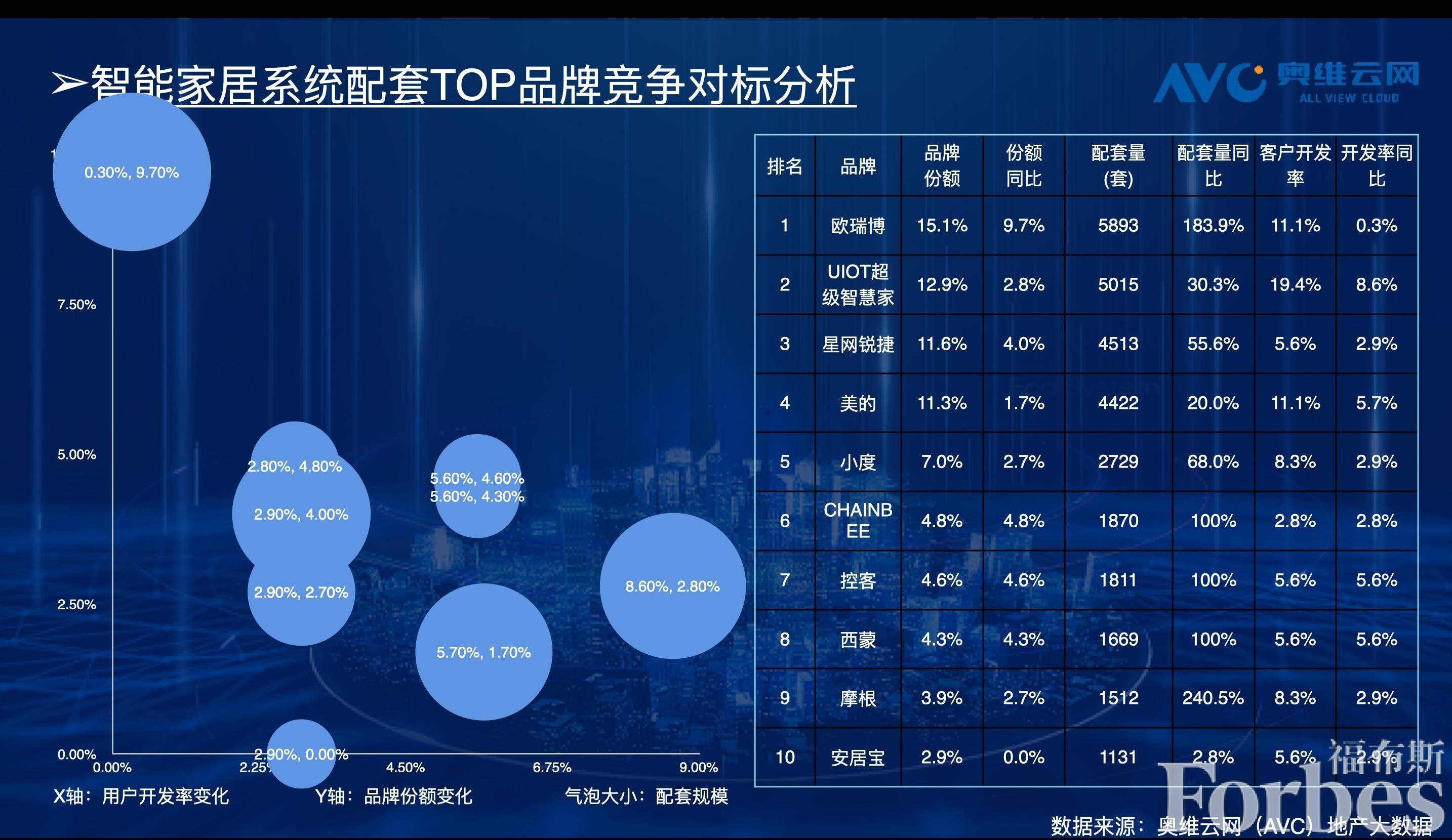 According to AVC's competitive analysis of smart-home system brands in China's fine-decoration segment for Q3 2021, ORVIBO holds a 15.1% market share, ranking first. In first-tier cities its share reaches 48.9%, followed by Xiaodu at 32.6% and Xiaomi at 18.5%. Overall, ORVIBO has built whole-home intelligence with an innovative attitude and philosophy, delivering a seamless whole-home smart experience and surpassing the likes of Midea and Xiaomi in China's fine-decoration smart-home market. It is also worth noting that, unlike other manufacturers' standalone smart products, ORVIBO drives smart home into millions of households through whole-home intelligence. Its innovative attitude and philosophy, and the seamless whole-home experience it delivers, have won bulk-purchase orders from many top-100 brands and produced more than 300 high-end tech residential projects. It is a strategic partner of top-100 developers such as Country Garden and China Vanke, and leads the smart-home system supply market for fine-decorated housing. Overall, from assembled smart home to native whole-home intelligence, ORVIBO has consistently led industry trends. Drawing on its insight into the industry's development, it has driven industry change for years, extending from single smart products to all scenarios long ago and becoming the first Chinese smart-home innovator to launch all-intelligent scenarios. To let more consumers experience whole-home smart living, it introduced a smart-home retail service model built on “super positioning + super products + super experience + super customisation + super service”, and has established 1,000 whole-home intelligence stores across the country. Behind IDC's earlier forecast that China's smart-home shipments will exceed 500 million units by 2025 lies the fact that promoting whole-home intelligence solutions in the consumer market will be one of the key drivers of market growth. The report also notes that whole-home intelligence solutions in China are still at an early stage with low penetration; as living standards rise and awareness of the smart-home market grows, these solutions will enjoy broad room to develop, complementing the DIY market across products, channels and users, and propelling the smart-home market forward. For ORVIBO, the new round of financing will accelerate the opening of whole-home intelligence super-experience stores across the country, offering end users native whole-home intelligence: starting from the intelligence of the living space as a whole, building a unified, multi-modal interaction and a proactive-intelligence-based underlying operating system, and using it to design the intelligent experience of the home's basic environment. It provides end users with one-stop, all-category, all-scenario smart-home installation and commissioning services, so that more ordinary users can enjoy the smart upgrade of their homes without any barrier to entry. This also raises the curtain on the whole-home intelligence era. Companies like ORVIBO whose business model has been validated are more likely to become capital's darlings. ORVIBO has already entered the IPO tutoring stage, and this huge injection of capital will certainly accelerate its capitalisation. Final Thoughts New technologies such as artificial intelligence and the Internet of Things are injecting innovative vitality into every industry. On the consumer side, devices empowered by AI become smart devices: a finger tap or a spoken word is enough to command everything at home — from switches to large appliances, from door locks to curtains — achieving intelligent control and even a “touch-free” service experience, catering to humanity's endless pursuit of a better life. For players on this track, solid products are not enough — they must also build an ecosystem. Only by delivering whole-home intelligence that makes smart family living a reality do they hold the key to winning in the smart-home market and reaping its dividends. Previous Official Announcement | Euromo |